Disability News, Benefits, and Health Resources
Seventy million American adults live with a disability. Another 1.3 billion people worldwide (about the combined population of Europe and North America) share that experience, roughly 16 percent of the global population.
Disabled World (DW), also known to many readers as Disability World, reports on the policies, research, benefits, and assistive technology that shape their lives. Coverage centers on the United States: Social Security and SSI payments, Medicare and Medicaid rules, accessibility law, and medical research relevant to American readers. International stories appear where they intersect with American policy or practice. Disabled World has been publishing since 2004 under the banner Towards Tomorrow. Learn more about us.
"Disability is the only minority group that anyone can join at any time." - a widely shared saying in the disability community, often attributed to American comedian Josh Blue.
Popular Pages
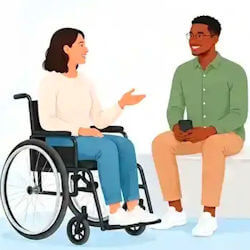
Disability Loans and Grants
Financial assistance programs for low-income families, seniors, and disabled students.
Famous People with Disabilities
Well-known people with various disabilities and conditions who have contributed to society.
Disability and Health Statistics
Data, charts, and facts on prevalence, demographics, and trends.
Awareness Ribbon Colors
Guide to awareness ribbon colors for health, medical conditions, disability, and other causes.
Child to Teen Height to Weight Ratio Charts
Average height-to-weight ratios for children and teens, organized by age.
Recent Disability News and Information
Anti-Coaching: Function, Access and Constraint in 13 Famous Lives
How FDR, Helen Keller, Stephen Hawking, Beethoven and nine others worked with disability by redesigning function, access and support, not willpower alone. Published: 12 Nov 2026.
Franklin D. Roosevelt: Polio, Disability and Presidency
How Franklin D. Roosevelt governed with paralysis after polio, relying on leg braces, wheelchairs, aides, Warm Springs and a carefully managed public image. Published: 11 Nov 2026.
Oksana Masters: Adapting Performance to a Changing Body
Paralympian Oksana Masters medaled in rowing, Nordic skiing, biathlon and cycling, showing how elite performance adapts as amputation and injury reshape a body. Published: 8 Nov 2026.
Charles Schwab and Dyslexia: Building Around Weak Spots
How Charles Schwab, diagnosed with dyslexia at 47, built a business by hiring for his deficits, and why the dyslexia superpower story overlooks the real lessons. Published: 5 Nov 2026.
Helen Keller: Language Access, Education and Independence
Helen Keller's path from childhood gestures to Radcliffe and socialist writing shows how access to language, books and teaching shaped her independent thought. Published: 2 Nov 2026.
Disability Pluralism: Understanding Many Ways of Being Human
Pluralism in disability explained: how the social model, the UN CRPD, Deaf culture and neurodiversity frame disability as a valued part of human diversity. Published: 31 Oct 2026.
Human Spine and Vertebrae Guide
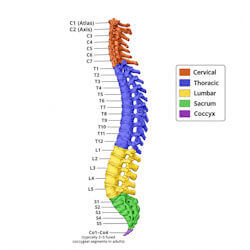
The human spine is a column of 33 vertebrae that holds the body upright, allows it to bend and twist, and protects the spinal cord. Our human spine vertebrae guide covers each level from C1 to S5 and how a spinal cord injury at each level can affect function.
Cervical (C1 to C7): Seven neck vertebrae that support and turn the head. Injuries here can affect breathing and arm and hand use.
Thoracic (T1 to T12): Twelve upper and mid back vertebrae, each joined to a pair of ribs. Injuries here can affect trunk balance.
Lumbar (L1 to L5): Five large lower back vertebrae that carry most of the body's weight. Injuries here can affect the hips and legs.
Sacrum and Coccyx (S1 to S5, Co1 to Co4): Five vertebrae fused into one bone at the back of the pelvis, with the small tailbone below. Nerves here serve bowel and bladder control.
Newly Updated Pages
Känna Sensory-Friendly Clothing for Neurodivergent Kids: Känna is a UK brand making sensory-friendly clothing for neurodivergent kids, with tagless labels, soft seams, stretchy waistbands and brushed organic cotton.
Neurodiversity in the Classroom: Strength-Based Teaching: Thomas Armstrong's Neurodiversity in the Classroom gives teachers strength-based strategies and positive niche construction to help students with special needs.
Human Spine Vertebrae C1 to S5: Anatomy and Injury Levels: Guide to human spine vertebrae from C1 to S5, covering cervical, thoracic, lumbar and sacral anatomy and how spinal cord injury at each level affects function.